Integrated CIPR news on your desktop – shame about mobile

ciprnewsroom

The Chartered Institute of Public Relations (CIPR) launched a social media newsroom on January 23. In  their words, it “integrates announcements on our website with our Twitter feed, Facebook and LinkedIn pages and with the CIPR Conversation.”

It’s a good example of an organization evolving how it communicates information about itself (and, in this case, about a profession and its membership) and how it enables easier sharing of its content in ways that are measurable, eg, social-share buttons, and linking content in diverse online places.

I heard about the newsroom yesterday when I was out and about in London. I’d just finished a meeting so a moment to check email, Twitter and Google+ on my mobile device. No wifi at that moment but a good connection via 3 UK’s cellular network. A note on G+ from David Philips had the news. Naturally, I clicked the link and headed over in my mobile browser to take a look.

What a disappointment! What I got was the desktop website squeezed onto the 4.3-inch display on my Samsung Galaxy SII smartphone.

SC20120126-141818-2

The news site – indeed, the entire CIPR website – doesn’t offer a version that’s designed for use on a mobile device. As you can see from the screenshot, the site is, in essence, unusable on a mobile device like a smartphone.

Yesterday on Twitter, the CIPR’s Andrew Ross said that they haven’t yet made the step to a mobile site. Matt CIPR added that a mobile version is in the pipeline, “but it should still display ok on most smart phones.”

Hmm, I guess that depends on how you define “ok” in this context. In my initial experience, definitely not ok.

Think about it: you’re out and about, you want to see something on the CIPR’s website – read a news announcement, check some information, sign up for a course, maybe add a comment on The Conversation – but you get only the desktop website on your mobile. And that gives you the desktop experience – not really workable on a mobile device like a phone.

Just try the screen-pinching, squinting, “precision” finger-tapping and swiping in a busy Starbucks, never mind on a crowded bus. And if your cell connection isn’t that good, it will be like watching paint dry as the page attempts to load in all its graphical glory.

Not something you want to do more than once.

Undoubtedly the experience will be better on a larger-screen mobile device, eg, an iPad or one of the myriad Android tablets with their seven- to ten-inch screens. But display is only one part of the picture, as it were – great to be able to clearly see what you want, it’s then how you use that content on a device that you touch to interact, not point and click or hit an enter key.

Whether or not we’re embarking on the “Post PC Era,” there is no question that the “Mobile Era” is here.

Smartphones have become an integral part of people’s daily lives wherever they are: we use smartphones as an extension – even a replacement – of our desktop or laptop computers these days as we multi-task and, whether it’s for business or personal, consume and quickly share other content.

I do hope a CIPR mobile-optimized site comes very soon. In the meantime, enjoy what is a good resource on your desktop.Just don’t expect much if you try it on a mobile.

Related posts:

FIR Interview: Walgreens Social Media Director Adam Kmiec

FIR co-hosts Neville Hobson and Shel Holtz interview Adam Kmiec, director of social media for Walgreens, the largest drug store chain in the US and a Fortune 50 company.

itsmyWalgreens has engaged in the last 10 days or so in a social media-focused effort to build awareness among customers of alternatives to Express Scripts, the prescription benefit manager through which hundreds of thousands of people in the US pay for their prescription medications. Unable to reach an agreement to renew their contract, Walgreens no longer accepts Express Scripts but using mechanisms like Prescription Savings Club membership to retain customers.

The campaign to build awareness and retain customer loyalty has been largely focused on social media, including paid tactics like promoted Twitter trends and sponsored blog posts. In this wide-ranging interview, Kmiec outlines the challenges of the campaign, discusses the importance of statistical insights to drive decision-making, and the use of paid social media, as well as outcomes of the effort to date.

(The Walgreens campaign was covered by Advertising Age and was the subject of a story covered on FIR #634 on January 16. That FIR report was covered by the Best O Pop blog.)

Get this podcast:

About our Conversation Partner

adamkmiecFor more than 14 years, Walgreens Social Media Director Adam Kmiec has worked for some of the most forward thinking organizations in the world, while helping some of the most dynamic brands find success in the interactive and social space. His career spans both the client and agency sides of the marketing and advertising industry, covering stops at renowned organizations that include Fallon, Leo Burnett, and ConAgra Foods. His focus has always been on solving business problems by leveraging consumer driven insights to fuel creative ideation.

He is a frequent speaker and news contributor. He is currently working on a book titled Yes, It’s Hypocritical due for completion next summer.

Connect with Adam on Twitter @adamkmiec or via other social networks.

FIR on Friendfeed
Share your comments or questions about this podcast, or suggestions for future interviews, in the FIR FriendFeed Room. You can also email us at fircomments@gmail.com; call the Comment Line at +1 206 222 2803 (North America), +44 20 3239 9082 (Europe), or Skype: fircomments; comment at Twitter: twitter.com/FIR. You can email your comments, questions and suggestions as MP3 file attachments, if you wish (max. 3 minutes / 5Mb attachment, please!). We’ll be happy to see how we can include your audio contribution in a show.

To receive all For Immediate Release podcasts including the weekly Hobson & Holtz Report, subscribe to the full RSS feed.

This FIR Interview is brought to you with Lawrence Ragan Communications, serving communicators worldwide for 35 years. Information: www.ragan.com.

Podsafe music – On A Podcast Instrumental Mix (MP3, 5Mb) by Cruisebox.

(Cross-posted from For Immediate Release, Shel’s and my podcast blog.)

Hollywood had Chris Dodd and a press release, Silicon Valley had Facebook

A nice sound bite in a frothy report by US entertainment industry columnist and blogger +Sharon Waxman about yesterday’s online protests against SOPA and PIPA.

If you remember the core of this issue, it’s seen by many as Hollywood and vested interests versus the rest of us. Sort of the 1% against the 99%.

I’m not sure I’d liken it to a war zone – emotional rhetoric isn’t really helpful – yet this assessment looking at the PR aspects isn’t bad at all.

The bottom line:

It seems that Hollywood still does not realize that it is in the information age. Knowledge moves in real time, and events move accordingly. The medium is the message in a fight like this.

Embedded Link

Sunk! How Hollywood Lost the PR Battle Over SOPA | The Wrap Media
Hollywood had Chris Dodd and a press release. Silicon Valley had Facebook

Google+: View post on Google+

Post imported by Google+Blog. Created By Daniel Treadwell.

To extend Waxman ‘s analogy a little further, battle may be won yesterday but a war still wages.

On the matter of the MPAA press release, I like Ike Pigott’s suggested edits that would make the message a little more authentic. :)

Related post:

The SOPA blackout

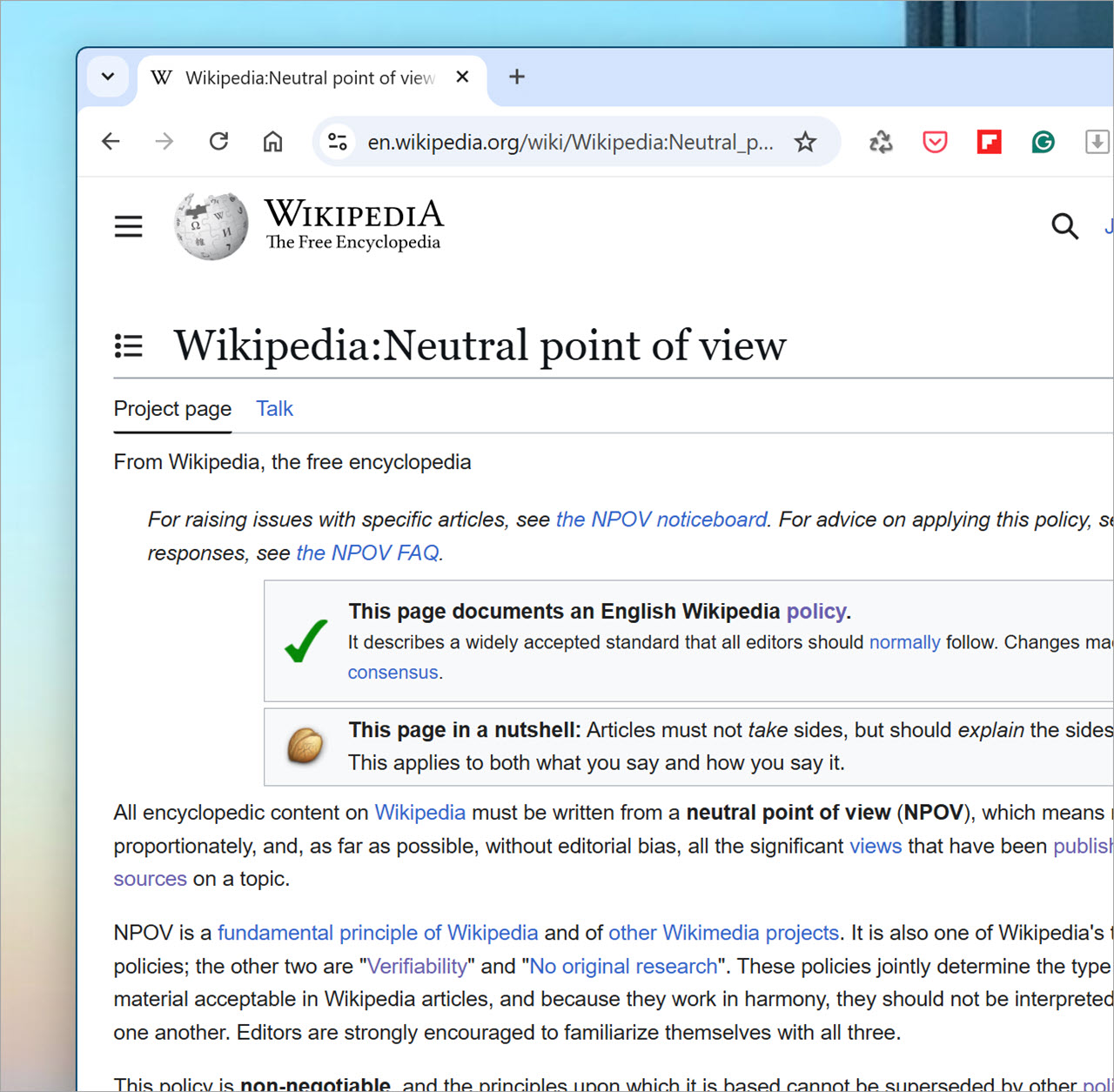
From 5am GMT today, January 18, one of the top-ten most visited websites on the internet is unavailable for 24 hours – if you visit English-language Wikipedia, you’ll just get a page with a text concisely explaining why you can’t get the content you came for.

wikipediablack18jan12

In a press release on January 16, the Wikimedia Foundation – owner of Wikipedia – said:

[...] the Wikipedia community has chosen to blackout the English version of Wikipedia for 24 hours, in protest against proposed legislation in the United States — the Stop Online Piracy Act (SOPA) in the U.S. House of Representatives, and PROTECTIP (PIPA) in the U.S. Senate. If passed, this legislation will harm the free and open Internet and bring about new tools for censorship of international websites inside the United States.

(For more about SOPA and PIPA, Google has some easy-to-understand information focused on the US; the BBC looks at SOPA and PIPA from the broader international perspective.) [Later: BBC technology correspondent Rory Cellan-Jones adds a depth assessment of SOPA and PIPA in his report Wikipedia - what can it tell us about Sopa?]

Wikipedia isn’t the only web resource to go offline today – other high-profile sites include Boing Boing and Reddit (the latter only for 12 hours). It’s notable that the heavyweights on the social web are conspicuous by their absence of action like today’s. So you’ll find business as usual at places like Twitter, Facebook and Google+.

As a way to raise awareness of the twin legislative approaches being addressed by US elected representatives, it will undoubtedly have a big impact, particularly in the US. I wonder, though, what Wikipedia’s (and the others’) measurable goal is. Or is it sufficient to simply get awareness raised around the world and over time we might see some kind of result? After all, SOPA itself is off the legislative agenda for now.

Plenty of opinion on that.

In the meantime, what will you do if you can’t get Wikipedia content today? You could try others from a dozen alternative resources Mashable suggests. If you speak other languages and if you’re looking for explanations of things rather than simply linking to them, try the other language versions of Wikipedia – they’re all up.

Or simply postpone your “what, why, how and where” searching just for a day. It’ll all be there again tomorrow.

[Update 1100 GMT] I discovered that I can access much of Wikiepdia on the mobile website. So far, every page I’ve gone to on my mobile device has shown up.

Actually, the mobile website works on a desktop computer too. Try it for yourself. Not everything will show up – some links redirect to the main website and you’ll get the blackout overlay page. Best bet: use the mobile site on your mobile device if you can’t do without English Wikipedia for a day.

It’s not much of a blackout from what I can see.

Three candidates for new PR definition

prwordcloudThe PRSA-led global initiative to find a new definition for public relations has moved into an interesting phase as it extends the time for deciding on what will be the one.

Rather than the PRSA and its global partners choose from three candidate definitions, those candidate definitions have been posted publicly to encourage further public discussion.

In an update posted earlier this week, incoming PRSA president Gerard Corbett said practitioners have until January 23 to express their initial reactions to these draft definitions, adding:

[...] We’ll then aggregate and analyze your feedback in preparation for a second “Definition of PR” summit meeting with our international partners, from which three final definitions will arise for voting by the profession. This additional step, we feel, will engender greater input and, ultimately, ensure we achieve the broadest possible consensus on — and satisfaction with — the new, modern definition of public relations.

So, here are the three #PRDefined Candidate Definitions:

Definition No. 1:

  • Public relations is the management function of researching, engaging, communicating, and collaborating with stakeholders in an ethical manner to build mutually-beneficial relationships and achieve results. (Annotated version here.)

Definition No. 2:

  • Public relations is a strategic communication process that develops and maintains mutually-beneficial relationships between organizations and their key publics. (Annotated version here.)

Definition No. 3:

  • Public relations is the engagement between organizations and individuals to achieve mutual understanding and realize strategic goals. (Annotated version here.)

If you have a view, add your voice in a comment to Gerard Corbett’s post (there are over 100 comments there already). Remember, the deadline is January 23.

Related post: