



 In the midst of seeming never-ending debate and argument about how the mainstream media will remain relevant and make money – when, for instance, The Times and Sunday Times now charge you to access news as well as other content on their websites – comes an entirely different approach to the paywall concept with The Guardian News Feed plugin for WordPress.
This nifty tool goes way beyond simply getting access to news content on The Guardian website. You can certainly do that as can anyone: The Guardian, like nearly every other newspaper, doesn’t charge for access to its content.
Where this gets interesting is that it enables you to access content from The Guardian online and re-publish it verbatim on your WordPress blog. In effect, you become an extension of The Guardian, and can value-add your own content to that of The Guardian’s that you re-publish.
Here’s an example of a story in the Guardian that I published here earlier today.
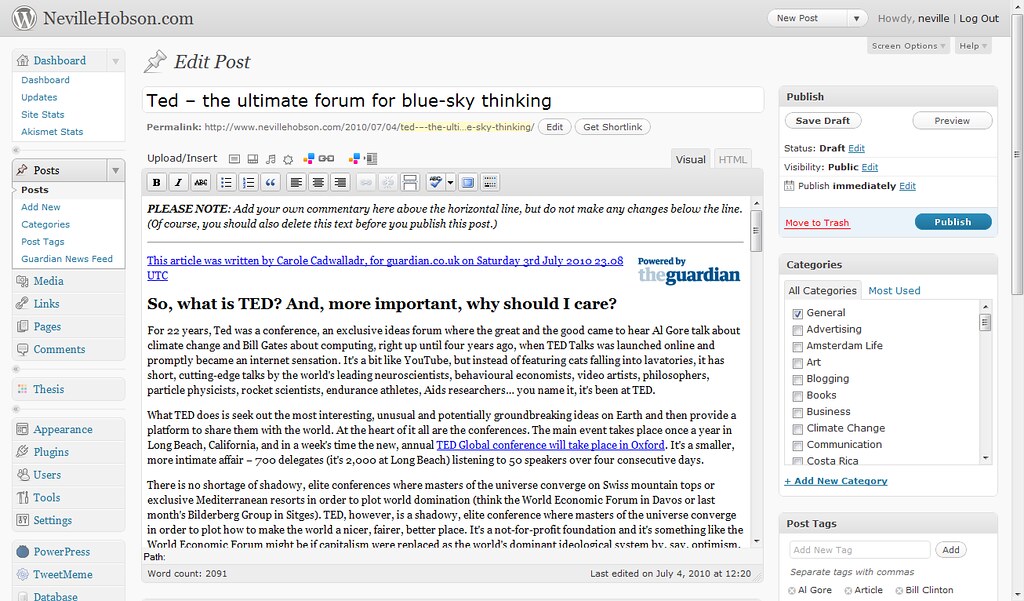
The screenshot above (click to see it larger) shows the edit post page in this blog’s admin: the page you see if you write posts directly in the blog. It’s populated with the 2000-word content of a story published in The Guardian, done automatically by the plugin’s admin page from a story that I chose from a huge list of content at The Guardian: screenshot below (click to see it larger).

The Guardian’s content is free to access and re-publish under very clear conditions: no changing any of the content including the ads. Yes, it’s ad supported.
It’s extremely easy to set up and use: once you’ve installed the plugin and obtained the required API key, you’re ready to simply choose a story, edit it if you want, and publish it in your own blog.
So how or where does this Guardian initiative fit into the overall picture of consumers paying for access to content online?
Not anywhere obvious. News and other content on The Guardian website is freely available (ie, you’re not required to register to pay any subscription fee) although you do need to register if you want to comment on anything on the site.
The Guardian is an open book, so to speak, not competing with The Times and Sunday Times paywall models; nor, for that matter those long established pay-for-access models used by the Financial Times and The Economist.
So where does it fit?
You need to think of a newspaper like The Guardian not simply as a “digital newspaper” any more. More than any other mainstream medium I can think of, The Guardian’s approach to the thorny topic of consumers paying for content has moved in a different direction, more to do with opening up the paper to the web than looking at how to monetize content by persuading people to come to your website to access that content.
That’s according to The Guardian’s Matt McAlister in an interview with GigaOm published on July 2:
[…] the rationale behind both the open platform and the WordPress plugin is the same: to allow other sites and services to make use of the newspaper’s content, and at the same time to enlist them as partners in monetizing that content by carrying advertising (The Guardian also has platform partners who share the revenue from their services with the newspaper). The paper has had thousands of developers sign up to implement the open API.
At a time when newspapers like The Times of London and the Sunday Times are implementing paywalls […] and other newspaper, such as the New York Times, are working on their own pay restrictions, The Guardian’s move toward creating an open platform is unusual. But despite the newspaper’s losses, Guardian editor-in-chief Alan Rusbridger has said that an open strategy is the key to the newspaper’s future.
More at GigaOm including a 5-minute video interview with Chris Thorpe, The Guardian’s developer advocate until the end of May.
I like the idea of what The Guardian is doing with this WordPress plugin. I can imagine using it to re-publish content from the newspaper online if that content is interesting enough that I can add some commentary or opinion to the post that would appear here.
It’s not clear to me yet how the monetization aspect works – do I get a cut of revenue from clicks on the ads? – but I’m happy to go along with publishing for the time being. After all, I benefit too by having some great content from a reliable and trusted source to share from this blog.
So from a content publisher’s point of view, instead of trying to bring consumers to your content, you enable your content to go to consumers via outlets other than your own.
Maybe there’s room for every idea that gives people what they want (compelling content)Â and that they might be willing pay for, one way or another, so that content publishers get what they want (revenue).
It could be that simple.
Related posts:





63 responses to “The Guardian extends its open platform with WordPress plugin”
[Blog] The Guardian extends its open platform with WordPress plugin http://tinyurl.com/27gq77r #fb #in
[nh.com] The Guardian extends its open platform with WordPress plugin http://goo.gl/fb/kDw50
The Guardian Extends its Open Platform into WordPress – New plugin http://tinyurl.com/27gq77r #fb #in thx 2 @jangles
RT @jangles: [nh.com] The Guardian extends its open platform with WordPress plugin http://goo.gl/fb/kDw50 // Interesting but sucks for SEO
RT @RobinGood: The Guardian Extends its Open Platform into WordPress – New plugin http://tinyurl.com/27gq77r #fb #in thx 2 @jangles
RT @minxymoggy: RT @jangles: Guardian extends open platform with #wordpress plugin http://goo.gl/fb/kDw50 // Interesting but sucks for SEO
RT @jangles: [nh.com] The Guardian extends its open platform with WordPress plugin http://goo.gl/fb/kDw50
RT @jangles: [nh.com] The Guardian extends its open platform with WordPress plugin http://goo.gl/fb/kDw50 (via @tjompa)
[nh.com] The Guardian extends its open platform with WordPress plugin http://goo.gl/fb/kDw50 (via @jangles, @tjompa)
RT @jangles: [nh.com] The Guardian extends its open platform with WordPress plugin http://goo.gl/fb/kDw50
RT @jonasl: RT @jangles: [nh.com] The Guardian extends its open platform with WordPress plugin http://goo.gl/fb/kDw50 (via @tjompa)
[…] See my separate post for commentary about the plugin: The Guardian extends its open platform with WordPress plugin. […]
RT @jangles: [Blog] The Guardian extends its open platform with WordPress plugin http://tinyurl.com/27gq77r #fb #in
The Guardian extends its open platform w/ #WordPress plugin – http://mrte.ch/6rm RT @jonasl @jangles
The Guardian extends its open platform w/ #WordPress plugin – http://mrte.ch/6rm RT @jonasl @jangles http://goo.gl/fb/fGoY0
The Guardian extends its open platform with WordPress plugin http://ow.ly/17ZQpA
Twitter Comment
RT @jangles: [Blog] The Guardian extends its open platform with WordPress plugin [link to post] #fb #in
– Posted using Chat Catcher
The Guardian extends its open platform with WordPress plugin http://bit.ly/d5Fs2W
Twitter Comment
[Blog] The Guardian extends its open platform with WordPress plugin [link to post] #fb #in
– Posted using Chat Catcher
Twitter Comment
The Guardian Extends its Open Platform into WordPress – New plugin [link to post] #fb #in thx 2 @jangles
– Posted using Chat Catcher
Twitter Comment
RT @RobinGood: The Guardian Extends its Open Platform into WordPress – New plugin [link to post] #fb #in thx 2 @jangles
– Posted using Chat Catcher
RT @JesseNewhart: The Guardian extends its open platform with WordPress plugin http://bit.ly/d5Fs2W
RT @JesseNewhart: The Guardian extends its open platform with WordPress plugin http://bit.ly/d5Fs2W
An innovative way for newspapers to make money online >> The Guardian extends its open platform with WordPress plugin http://bit.ly/9ZR58A
The Guardian extends its open platform with WordPress plugin — NevilleHobson.com http://bit.ly/9LCOOG
Will 'reblogged' ads save newspaprs? RT @jangles: Guardian extends open platform with WordPress plugin http://tinyurl.com/27gq77r #fb #in
Interesting idea ==> The Guardian extends its open platform w/ #WordPress plugin http://bit.ly/d5Fs2W (via @joehall & @JesseNewhart)
Twitter Comment
Will ‘reblogged’ ads save newspaprs? RT @jangles: Guardian extends open platform with WordPress plugin [link to post] #fb #in
– Posted using Chat Catcher
Guardian extends its open platform w/ WordPress plugin http://j.mp/9TBWU9 w/ Example #Journalism
Signed up, Neville! Well, registered. Still need to decide how to approach the API application.
And also need to work out how to use it. I've had a piece published in The Guardian, and I'd certainly like to showcase that. I'd also be interested in posting some more of the environmental content… experimentation will continue, once I'm in!
Useful post that's got me experimenting – many thanks,
Richard.
I'm not a fan of this approach. I think it's a good option for those who are lazy and insecure about the dedication of their blog readers. It's great for newspapers who have gotten so desperate that they'll try anything. It's not good for blog followers. When I subscribe to a blog I do so to get the ideas and opinions of the people that are behind the blog. I don't subscribe to be fed random stories from any major news outlet. I'd rather see one good post a month on a blog than ten poorly written ones solely meant to remind people that you're still alive. In short, I don't want the blogs I read to be an extension of a newspaper. I want them to be an extension of the person or persons that are writing the blog.
RT @Skitzzo: Interesting idea ==> The Guardian extends its open platform w/ #WordPress plugin http://bit.ly/d5Fs2W (via @JesseNewhart)
Interesting move – The Guardian offers a WordPress plugin so you can put their content on your site. http://bit.ly/d5Fs2W
RT @mtext: Guardian extends its open platform w/ WordPress plugin http://j.mp/9TBWU9 w/ Example #Journalism
FriendFeed Comment
The Guardian extends its open platform with WordPress plugin [link to post]
– Posted using Chat Catcher
The Guardian extends its open platform with WordPress plugin http://ow.ly/2711D
Publishing evolves again.. The Guardian extends its open platform with WordPress plugin http://ow.ly/2714A
RT @_CowBell: Publishing evolves again.. The Guardian extends its open platform with WordPress plugin http://ow.ly/2714A
RT @_CowBell: Publishing evolves again. The Guardian extends its open platform with WordPress plugin http://ow.ly/2714A >interesting!
RT @lucynixon: RT @_CowBell The Guardian extends its open platform with WordPress plugin http://ow.ly/2714A >interesting!
"The #Guardian extends its open platform with #WordPress #plugin" von @jangles http://bit.ly/9FLXUi #journalism
Publishing evolves again. The Guardian extends its open platform with WordPress plugin http://ow.ly/2714A >interesting! (via @lucynixon)
Twitter Comment
“The #Guardian extends its open platform with #WordPress #plugin” von @jangles [link to post] #journalism
– Posted using Chat Catcher
RT @_CowBell: …The Guardian extends its open platform with WordPress plugin http://ow.ly/2714A >far more imaginative than paywall concept
"The #Guardian extends its open platform with #WordPress #plugin" by @jangles http://bit.ly/9FLXUi #journalism
Thanks for the great feedback, Neville. I just wanted to clarify the ad model for you.
You got it right – we can offer Guardian articles for you to republish freely because it is ad supported. The Open Platform license was designed to be mutually beneficial. We will embed advertising with content you republish and keep that revenue for the Guardian, and you can sell and keep your own advertising on pages where Guardian content is appearing on your web site.
This helps develop our ad network business further:
http://www.guardian.co.uk/ad-networks
We're also looking at deeper ways of partnering with bloggers and publishers. We've started down that path already with BabyBarrista.com:
http://www.guardian.co.uk/law/baby-barista-blog…
Let us know if you have any more thoughts on the plugin. We're eager to make it as useful as possible.
Thanks,
Matt
Twitter Comment
“The #Guardian extends its open platform with #WordPress #plugin” by @jangles [link to post] #journalism
– Posted using Chat Catcher
I think this is an excellent idea and a win-win situation: the newspaper gets more exposure and more advertising partners, while the publishers get good quality content for their websites, even if it's duplicate. There are so many sites which republish articles anyway, at least these articles will be good quality.
"The #Guardian extends its open platform with #WordPress #plugin" by @jangles http://bit.ly/9FLXUi #journalism
RT @jangles The Guardian extends its open platform with WordPress plugin http://is.gd/dgx2o #Leistungsschutzrecht #paywall
Thanks for some clarification on the ad model, Matt.
I'll give you more feedback in due course. Meanwhile, read what Rob has to say below :)
Forthright opinions, Rob, thanks. I'm not sure how I would use the plug-in (and, btw, for the record, I don't consider myself as lazy and insecure :)
If I can add something to a post, I would. In the Guardian's model, this would mean an intro commentary of some type at the beginning, separate from the Guardian's content under the terms of the license. That's fine although I can also see that some people would possibly just post the content without any commentary, which is where I guess you're coming from with your view.
We'll see how this all pans out. I would think that if anyone is simply re-publishing the Guardian's content and not much else, it would become apparent soon enough if readers didn't like that. Plus I've seen a number of people tweeting opinion that this model is no good for a blog's SEO. Not sure I follow that argument without some explanation.
Thanks Richard, look forward to hearing how it goes and what you think. Everyone's still learning.
Absolutely Neville., You're anything but lazy. It makes sense to try something out before you write it up. There are others who might see something like this and then create whole blogs out of these Guardian stories. The SEO issue is a factor too. Google has guidelines (http://www.google.com/support/webmasters/bin/an…) regarding duplicate content. It is possible that a lot of duplicate content could hurt the search rankings for your site. As always, caveat emptor.
Twitter Comment
RT @jangles The Guardian extends its open platform with WordPress plugin [link to post] #Leistungsschutzrecht #paywall
– Posted using Chat Catcher
The Guardian's new wordpress plugin – and answer to the paywall gang http://bit.ly/c2fFPc via @jangles
The Guardian's new wordpress plugin – and answer to the paywall gang http://bit.ly/c2fFPc via .@jangles and .@KatePickering
♺ @rajmarshall: The Guardian's new wordpress plugin – and answer to the paywall gang http://bit.ly/c2fFPc via .@jangles and .@KatePickering
RT @jangles The Guardian extends its open platform with WordPress plugin http://is.gd/dgx2o
The Guardian extends its open platform with WordPress plugin http://ff.im/-njac6
RT @alexdc: The Guardian extends its open platform with WordPress plugin http://ff.im/-njac6
RT @KatePickering: The Guardian's new wordpress plugin – and answer to the paywall gang http://bit.ly/c2fFPc via @jangles
[…] group concluded the show by discussing Neville Hobson’s post about The Guardian’s new WordPress plugin (at 29:20), which is yet another way print media is […]