



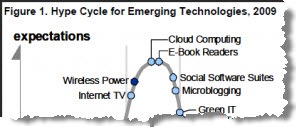
 It’s that time of year when industry analysts Gartner publish their annual hype cycle report for emerging technologies.
Last week, Gartner did indeed publish this year’s report, the Hype Cycle For Emerging Technologies 2009 report, available for clients to purchase for $1,995.00.
But unlike hype cycle reports in previous years – which I’ve reported on each year since 2006 – 2009 marks a new approach by Gartner that restricts usage of the charts from the report under a policy of tighter copyright and protection of intellectual property, updated on July 31.
What this means is that, as I’m not a client of Gartner, I can’t post the latest hype cycle chart here in this post without Gartner’s express permission. This situation seems clear from a perusal of their revised copyright and quote policy. So other than the image snip you see at the top of the page, that’s all that will be here unless I get permission from Gartner.
[Update Aug 6:] I did get permission from Gartner to post the graphic, so here it is. A specific post to come at some point soon.

That doesn’t seem to be stopping others, though, as you’ll see if you simply google for “gartner emerging technologies hype cycle 2009.”
It seems to me that Gartner haven’t got the balance right in protecting their intellectual property rights vs enabling legitimate third-party use of their imagery to support commentary and opinion about their research. I recorded some out-loud-thinking on this a bit earlier.
It’s fair enough to take steps to protect your copyright, as I mentioned before. And I respect Gartner’s right to that, which is why I haven’t simply gone ahead and used the latest chart.
But is this just too restrictive? Too rigid? Too controlled?
Would it not have been simpler for Gartner to enable casual use of the hype cycle chart in blogs and other online content that drives discussion and buzz about their research, recognizing that comment and opinion will be as wide and as varied as there are people with opinions, thus enriching the overall conversation about Gartner’s hype cycle?
How do you see it?
Related posts:





34 responses to “Gartner restricts usage of hype cycle graphics”
Hi Neville
Typically, organisations are delighted when bloggers and others talk about their products or services. One would wonder what the point of this restriction would be given the efforts that would be required to police it. As you highlight, there are plenty of websites out there that have the image of the hype cycle reproduced. Are Gartner going to contact each of these website owners and ask them to remove the image?
Gartner absolutely have a full copyright entitlement to their work and intellectual property. Nobody would dispute this. However a creative commons type approach here would be very beneficial for Gartner and more in keeping with the spirit of openness in the digital age. Allow people to reproduce the hype cycle but insist that attribution and a link to the full report (for purchase) on the Gartner website be provided.
That’s a very good suggestion re Creative Commons, Brendan, I agree.
Gartner say in their post announcing the new policy that it’s to do with ensuring correct interpretation of the chart information:
I would have th0ught that this would actually present Gartner with a terrific engagement opportunity: get in discussion with people using the chart on thsir blogs, point out where explanations aren’t wholly accurate, add and contribute to that conversation.
I think what Gartner needs is a Jeremiah Owyang . :)
FriendFeed Comment
Gartner restricts usage of hype cycle graphics — NevilleHobson.com [link to post]
– Posted using Chat Catcher
RT @pablodoblell: Fischerspooner en MX cortesÃa de @adryck <<< t super amo http://is.gd/b1mkQ /cort d q pago o cort de q t informe? :/
Twitter Comment
RT @jangles Gartner restricts usage of hype cycle graphics [link to post] I agree w/ commenter – seems perfect material for CC approach
– Posted using Chat Catcher
Twitter Comment
Decision seems counter to internet’s ‘ubiquitous’ qualities: Gartner restricts use of hype cycle graphics [link to post] @stevebridger
– Posted using Chat Catcher
Neville, Gartner is producing more specialized-domain Hype Cycle reports than ever this year (over 80,covering 1700+ technologies profiles). We release these in a wave of publication over a period of a couple of weeks and our public domain press release material does not proceed until after all of our clients have access. You are right to notice that one hype cycle chart – that for emerging technologies, often does see wider release. That is a tactical decision taken each year. Allow our PR department to do their work and by the end of the week I believe you will be happier. Thanks for your active interest in our research.
Hi Mark, appreciate your comment, thanks for stopping by.
Yes, I noticed that you are publishing a huge number of hype cycle reports. And I do understand the policy (especially so re what you say about all of your clients having access first – wonder why that point isn’t clearly stated as part of your reason for the more restrictive policy: it’s a reasonable reason).
I’ve requested permission to use the chart so I’ll patiently wait for a response (auto-responder email says up to 2 business days).
The Creative Commons ideas seems a good one, don’t you think?
Twitter Comment
RT @richardsedley Gartner restricts usage… [link to post] (via @stevebridger @jangles) (I say: What are they afraid of? Exactly.)
– Posted using Chat Catcher
Twitter Comment
Gartner restricts usage of hype cycle graphics [link to post] (via @stevebridger @jangles)
– Posted using Chat Catcher
Twitter Comment
@richardsedley From the Gartner’s site it looks more like a rulebook for Gartner clients how to use and not to use results (not only Graphs)
– Posted using Chat Catcher
Twitter Comment
RT @richardsedley: Gartner restricts usage of hype cycle graphics [link to post] (via @stevebridger @jangles)
– Posted using Chat Catcher
RT @richardsedley Gartner restricts usage… http://bit.ly/c7hUp (via @stevebridger @jangles) (I say: What are they afraid of? Exactly.)
RT @richardsedley: Gartner restricts usage of hype cycle graphics http://bit.ly/c7hUp (via @stevebridger @jangles)
Funny really, you’d think a company demonstrating its knowledge of technology and the web would understand the value of making these things clear…
Twitter Comment
Gartner restricts usage of hype cycle graphics (via @ConversationAge): [link to post]
– Posted using Chat Catcher
Twitter Comment
@ConversationAge thanks for the link to my Gartner hype cycle post. Getting lots of inbounds from your HootSuite :) [link to post]
– Posted using Chat Catcher
Twitter Comment
@jangles glad to be of service. The topic connected with me as company on the receiving end of such restrictions even buying svcs ;-)
– Posted using Chat Catcher
Twitter Comment
RT @ConversationAge: Gartner restricts usage of hype cycle graphics [link to post]
– Posted using Chat Catcher
Twitter Comment
Gartner restricts usage of hype cycle graphics [link to post]
– Posted using Chat Catcher
Gartner restricts usage of hype cycle graphics http://ow.ly/iR0X
Gartner restricts usage of hype cycle graphics (via @ConversationAge): http://ow.ly/iR0X
@ConversationAge thanks for the link to my Gartner hype cycle post. Getting lots of inbounds from your HootSuite :) http://ow.ly/iR0X
RT @ConversationAge: Gartner restricts usage of hype cycle graphics http://ow.ly/iR0X
There is a book, “HypeCycle,” that contains the generic hypecycle. That’s good enough for me. I don’t pay much attention to the specifics in the annual report, because I work at the front-end of the hypecycle where there is not data for any market research. The data is just descriptive of the pragmatist CIOs that I keep off my strategic roadmaps.
The hypecycle is a category issue. Most software vendors ride the hypecycle without trying to effect it. The market leader drives the hypecycle. Fast followers have no need to deal with the hypecycle at all.
The data in the annual reports cost Gartner quite a bit of money to develop. Gartner must earn their revenues from their efforts. Instead of just saying that the commons license would be better, tell Gartner where their sideband, multisided-market revenues can be found.
The hypecycle has its own issues much like the TCO.
Commented on the Neville Hobson.com post "Gartner restricts usage of hype cycle graphics," http://bit.ly/44DqIM
Why do they do that? Gartner restricts usage of hype cycle graphics http://bit.ly/3T6AgA #feedly #fb
I think, because of the restrictive policy of Gartner, there is less coverage of the release through blog post.
These are the same copyright restrictions Gartner has had for years. This policy is not aimed at bloggers or the press, but vendors. Gartner – like many analyst firms such as Forrester, IDC, etc – puts restrictions on vendors exploiting its content for marketing and selling purposes.
Check with Gartner’s public relations team for permission. I have always found Gartner to PR to be very responsive to requests.
Neville, It will be interesting to see what response you do get from Gartner on your response to reproduce their hype cycle. Do let us know, although I should have expected a response by now…
Gartner restricts usage of hype cycle graphics http://tr.im/wEUe
[…] had come across a post by Neville Hobson (2nd August) on Gartner restricts usage of hype cycle graphics, which discussed the subject of copyright. Gartner has a clearly defined policy on who can quote […]
[…] all the increasing talk is helping the topic rapidly ascend the Technology Trigger in Gartner’s 2009 hype cycle for emerging technologies published last […]
Gartner hype report for emerging technologies (with the graph) http://bit.ly/IHfH3